Interpretable Deep Learning for Industrial Fault Detection
DOI:
https://doi.org/10.63876/ijss.v1i2.74Keywords:
Interpretable Deep Learning, Fault Detection, Industrial Machinery, Explainable AI (XAI), Convolutional Neural Networks (CNN), Layer-wise Relevance Propagation (LRP)Abstract
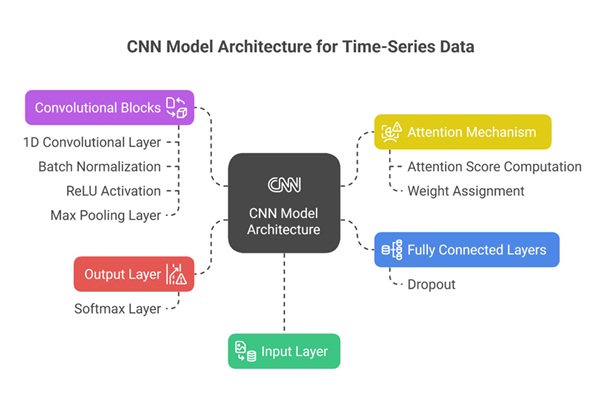
The integration of deep learning into industrial fault detection systems has significantly enhanced predictive accuracy and operational efficiency. However, the lack of model interpretability poses a critical barrier to its widespread adoption in safety-critical environments. This study proposes an interpretable deep learning framework that combines Convolutional Neural Networks (CNNs) with attention mechanisms and Layer-wise Relevance Propagation (LRP) to enable transparent fault diagnosis in complex machinery. Using a benchmark dataset from a rotating machinery system, the model achieves high classification performance while providing intuitive visual and quantitative explanations for its predictions. The attention module highlights critical temporal and spatial features, while LRP decomposes prediction scores to reveal feature-level contributions. Experimental results demonstrate that the proposed model not only maintains high accuracy (above 95%) but also delivers interpretable outputs that align with domain expert reasoning. Additionally, the model supports root cause analysis and facilitates trust in automated systems, which is essential for industrial stakeholders. This research bridges the gap between black-box deep learning models and real-world industrial applications by promoting transparency, accountability, and actionable insights. The proposed framework serves as a practical step toward deploying explainable AI in industrial settings, supporting both real-time monitoring and decision-making processes.
Downloads
References
K. Wenderott, N. Gambashidze, and M. Weigl, “Integration of Artificial Intelligence Into Sociotechnical Work Systems—Effects of Artificial Intelligence Solutions in Medical Imaging on Clinical Efficiency: Protocol for a Systematic Literature Review,” JMIR Res. Protoc., vol. 11, no. 12, p. e40485, Dec. 2022, doi: https://doi.org/10.2196/40485.
F. Abdoune, M. Nouiri, O. Cardin, and P. Castagna, “Integration of Artificial Intelligence in the life cycle of industrial Digital Twins,” IFAC-PapersOnLine, vol. 55, no. 10, pp. 2545–2550, 2022, doi: https://doi.org/10.1016/j.ifacol.2022.10.092.
B. Huy, N. Q. Truong, N. Q. Khiem, K. P. Poudel, and H. Temesgen, “Deep learning models for improved reliability of tree aboveground biomass prediction in the tropical evergreen broadleaf forests,” For. Ecol. Manage., vol. 508, p. 120031, Mar. 2022, doi: https://doi.org/10.1016/j.foreco.2022.120031.
E. Mahamedi, K. Rogage, O. Doukari, and M. Kassem, “Automating excavator productivity measurement using deep learning,” Proc. Inst. Civ. Eng. - Smart Infrastruct. Constr., vol. 174, no. 4, pp. 121–133, Dec. 2021, doi: https://doi.org/10.1680/jsmic.21.00031.
S. Ghungrad, B. Gould, M. Soltanalian, S. J. Wolff, and A. Haghighi, “Model-based deep learning for additive manufacturing: New frontiers and applications,” Manuf. Lett., vol. 29, pp. 94–98, Aug. 2021, doi: https://doi.org/10.1016/j.mfglet.2021.07.008.
P. W. Tien, S. Wei, J. Darkwa, C. Wood, and J. K. Calautit, “Machine Learning and Deep Learning Methods for Enhancing Building Energy Efficiency and Indoor Environmental Quality – A Review,” Energy AI, vol. 10, p. 100198, Nov. 2022, doi: https://doi.org/10.1016/j.egyai.2022.100198.
W. Li, H. Guan, Y. Han, H. Zhu, and A. Wang, “Short-Term Holiday Travel Demand Prediction for Urban Tour Transportation: A Combined Model Based on STC-LSTM Deep Learning Approach,” KSCE J. Civ. Eng., vol. 26, no. 9, pp. 4086–4102, Sep. 2022, doi: https://doi.org/10.1007/s12205-022-2051-8.
B. Debus, H. Parastar, P. Harrington, and D. Kirsanov, “Deep learning in analytical chemistry,” TrAC Trends Anal. Chem., vol. 145, p. 116459, Dec. 2021, doi: https://doi.org/10.1016/j.trac.2021.116459.
D. Gutierrez-Rojas et al., “A perspective on the enabling technologies of explainable AI-based industrial packetized energy management,” iScience, vol. 26, no. 12, p. 108415, Dec. 2023, doi: https://doi.org/10.1016/j.isci.2023.108415.
J. Zhou and Y. Zhu, “Automatic determination of optimal fault detection filter,” J. Process Control, vol. 118, pp. 69–81, Oct. 2022, doi: https://doi.org/10.1016/j.jprocont.2022.08.009.
F. Lugaresi, P. Kotsovinos, P. Lenk, and G. Rein, “Review of the mechanical failure of non-combustible facade systems in fire,” Constr. Build. Mater., vol. 361, p. 129506, Dec. 2022, doi: https://doi.org/10.1016/j.conbuildmat.2022.129506.
M. Cho, T. Kim, W. J. Kim, S. Cho, and S. Lee, “Unsupervised video anomaly detection via normalizing flows with implicit latent features,” Pattern Recognit., vol. 129, p. 108703, Sep. 2022, doi: https://doi.org/10.1016/j.patcog.2022.108703.
S. Zhao, J. Huo, R. Xu, Y. Liu, M. Jing, and B. Zhang, “Prevention of bund overtopping after a catastrophic tank failure accident: Effects of bund design, liquids and scale-up,” Process Saf. Environ. Prot., vol. 166, pp. 41–56, Oct. 2022, doi: https://doi.org/10.1016/j.psep.2022.07.062.
N. Van Noord and E. Postma, “Learning scale-variant and scale-invariant features for deep image classi fi cation,” Pattern Recognit., vol. 61, pp. 583–592, 2017, doi: https://doi.org/10.1016/j.patcog.2016.06.005.
C.-M. Tsai, Y.-H. Lai, Y.-D. Sun, Y.-J. Chung, and J.-W. Perng, “Multi-dimensional underwater point cloud detection based on deep learning,” Sensors (Switzerland), vol. 21, no. 3, pp. 1–18, 2021, doi: https://doi.org/10.3390/s21030884.
C. Zhang and X. Wu, “An improved Gaussian mixture modeling algorithm combining foreground matching and short-term stability measure for motion detection,” Multimed. Tools Appl., pp. 7049–7071, 2020.
I. Ahmed, G. Jeon, and F. Piccialli, “From Artificial Intelligence to Explainable Artificial Intelligence in Industry 4.0: A Survey on What, How, and Where,” IEEE Trans. Ind. Informatics, vol. 18, no. 8, pp. 5031–5042, Aug. 2022, doi: https://doi.org/10.1109/TII.2022.3146552.
A. Lombardi et al., “A human-interpretable machine learning pipeline based on ultrasound to support leiomyosarcoma diagnosis,” Artif. Intell. Med., vol. 146, p. 102697, Dec. 2023, doi: https://doi.org/10.1016/j.artmed.2023.102697.
M. T. Nakahata, L. A. Thomaz, F. Allan, A. B. Eduardo, and S. Sergio, “Anomaly detection with a moving camera using spatio-temporal codebooks,” Multidimens. Syst. Signal Process., vol. 29, no. 3, pp. 1025–1054, 2018, doi: https://doi.org/10.1007/s11045-017-0486-8.
C. F. Pasani and R. Amelia, “Learning Loss and Education Inequality in Indonesia ( Mapping the Potential , Consequences , and the Covid-19 Crisis ),” 2021.
W. Pedrycz and S. Chen, Development and Analysis of Deep Learning Architectures.
D. Szpilko, F. J. Naharro, G. Lăzăroiu, E. Nica, and A. de la T. Gallegos, “Artificial Intelligence in the Smart City — A Literature Review,” Eng. Manag. Prod. Serv., vol. 15, no. 4, pp. 53–75, Dec. 2023, doi: https://doi.org/10.2478/emj-2023-0028.
L. Liu et al., “LRP2A: Layer-wise Relevance Propagation based Adversarial attacking for Graph Neural Networks,” Knowledge-Based Syst., vol. 256, p. 109830, Nov. 2022, doi: https://doi.org/10.1016/j.knosys.2022.109830.
N. A. Salim, M. M. Othman, I. Musirin, and M. S. Serwan, “Identifying severe loading condition during the events of cascading outage considering the effects of protection system hidden failure,” in 2013 IEEE 7th International Power Engineering and Optimization Conference (PEOCO), IEEE, Jun. 2013, pp. 375–379. doi: https://doi.org/10.1109/PEOCO.2013.6564576.
A. Vera-Baquero, R. Colomo-Palacios, and O. Molloy, “Real-time business activity monitoring and analysis of process performance on big-data domains,” Telemat. Informatics, vol. 33, no. 3, pp. 793–807, 2016, doi: https://doi.org/10.1016/j.tele.2015.12.005.
J. Y. Kim and J. E. Ha, “Generation of Background Model Image Using Foreground Model,” IEEE Access, vol. 9, pp. 127515–127530, 2021, doi: https://doi.org/10.1109/ACCESS.2021.3111686.
M. Wischow, G. Gallego, I. Ernst, and A. Borner, “Monitoring and Adapting the Physical State of a Camera for Autonomous Vehicles,” IEEE Trans. Intell. Transp. Syst., pp. 1–14, 2023, doi: https://doi.org/10.1109/TITS.2023.3328811.
H. Haramina, M. Mandi, and E. Ivanjko, “Appliance of Intelligent Transportation Systems within the Moving Block Technology Moving Block technology Impact of Moving Block on Rail Traffic Efficiency,” pp. 433–438, 2012.
Surjandy et al., “Stakeholder Act as an IT and General Compliance Auditor,” in 2018 International Conference on Sustainable Information Engineering and Technology (SIET), IEEE, Nov. 2018, pp. 298–301. doi: https://doi.org/10.1109/SIET.2018.8693188.
S. Sugavanam, S. R. Nunns, and J. Walkington, “One Approach to Functional Safety Assurance and Safety Lifecycle Compliance,” in 8th IET International System Safety Conference incorporating the Cyber Security Conference 2013, Institution of Engineering and Technology, 2013, pp. 4.2-4.2. doi: https://doi.org/10.1049/cp.2013.1711.
O. Leitersdorf, Y. Boneh, G. Gazit, R. Ronen, and S. Kvatinsky, “FourierPIM: High-throughput in-memory Fast Fourier Transform and polynomial multiplication,” Memories - Mater. Devices, Circuits Syst., vol. 4, p. 100034, Jul. 2023, doi: https://doi.org/10.1016/j.memori.2023.100034.
P. B. C. Miranda, R. B. C. Prudêncio, A. P. L. F. De Carvalho, and C. Soares, “Neurocomputing A hybrid meta-learning architecture for multi-objective optimization of SVM parameters,” Neurocomputing, vol. 143, pp. 27–43, 2014, doi: https://doi.org/10.1016/j.neucom.2014.06.026.
H. Jin, Y.-G. Kim, Z. Jin, A. A. Rushchitc, and A. S. Al-Shati, “Optimization and analysis of bioenergy production using machine learning modeling: Multi-layer perceptron, Gaussian processes regression, K-nearest neighbors, and Artificial neural network models,” Energy Reports, vol. 8, pp. 13979–13996, Nov. 2022, doi: https://doi.org/10.1016/j.egyr.2022.10.334.
J. Peral, A. Maté, and M. Marco, “Application of Data Mining techniques to identify relevant Key Performance Indicators,” Comput. Stand. Interfaces, vol. 50, pp. 55–64, 2017, doi: https://doi.org/10.1016/j.csi.2016.09.009.
L. Liu et al., “Deep Learning for Generic Object Detection: A Survey,” Int. J. Comput. Vis., vol. 128, no. 2, pp. 261–318, 2020, doi: https://doi.org/10.1007/s11263-019-01247-4.
Y. G. Jiang, Z. Wu, J. Tang, Z. Li, X. Xue, and S. F. Chang, “Modeling multimodal clues in a hybrid deep learning framework for video classification,” arXiv, vol. 20, no. 11, pp. 3137–3147, 2017.
S. Xue, M. Yang, X. Huang, and D. Xu, “Bearing Fault Detection Using Multipoint Optimal Minimum Entropy Deconvolution Adjusted of Motor Speed,” in 2021 24th International Conference on Electrical Machines and Systems (ICEMS), IEEE, Oct. 2021, pp. 2191–2195. doi: https://doi.org/10.23919/ICEMS52562.2021.9634588.
D. I. Mulyana, A. C. Aditya, S. Amelia, and S. Agustiansyah, “Implementasi Framework Mask R-CNN Object Detection API Dalam Mengklasifikasi Jenis Kendaraan Bermotor,” J. Tek. Elektro dan Komputasi, vol. 4, no. 1, pp. 63–72, 2022, doi: https://doi.org/10.32528/elkom.v4i1.7148.
S. Ghosh, S. J. Sunny, and R. Roney, “Accident Detection Using Convolutional Neural Networks,” 2019 Int. Conf. Data Sci. Commun. IconDSC 2019, pp. 3–8, 2019, doi: https://doi.org/10.1109/IconDSC.2019.8816881.