Adaptive Federated Learning for Privacy-Preserving Smart Applications
DOI:
https://doi.org/10.63876/ijss.v1i2.73Keywords:
Adaptive Federated Learning, Privacy-Preserving AI, Smart Applications, Differential Privacy, Secure Aggregation, Heterogeneous DataAbstract
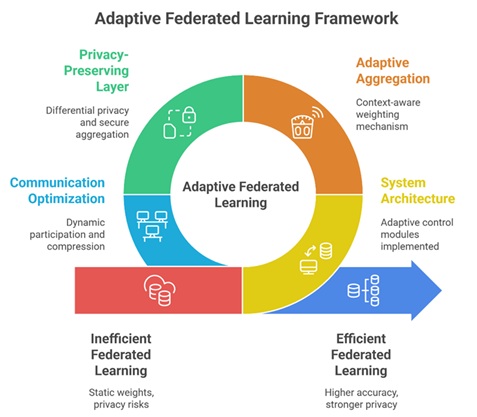
The rapid growth of smart applications across domains—ranging from healthcare and finance to personalized education—has intensified concerns about data privacy and model scalability. Federated Learning (FL) offers a promising framework by enabling distributed model training without sharing raw data, yet conventional FL approaches struggle with challenges such as heterogeneous data distributions, limited device resources, and dynamic network conditions. This paper introduces an Adaptive Federated Learning (AFL) framework designed to address these limitations while preserving user privacy. The proposed AFL dynamically adjusts aggregation strategies, learning rates, and participation levels based on client performance metrics and resource availability. We integrate differential privacy mechanisms and secure aggregation to ensure robust privacy guarantees without compromising model accuracy. Experimental evaluations on benchmark smart application datasets—including IoT sensor data and mobile user behavior logs—demonstrate that AFL achieves up to 15–20% improvement in convergence speed and notable reductions in communication overhead compared to standard FL methods. Our findings highlight AFL’s potential as a scalable and privacy-preserving solution for next-generation smart applications, paving the way for more secure and adaptive AI ecosystems.
Downloads
References
J. J. Peralta Abadía, C. Walther, A. Osman, and K. Smarsly, “A systematic survey of Internet of Things frameworks for smart city applications,” Sustain. Cities Soc., vol. 83, p. 103949, Aug. 2022, doi: https://doi.org/10.1016/j.scs.2022.103949.
A. Naseem Alvi, M. Awais Javed, M. Hoque Abul Hasanat, M. Badruddin Khan, A. Khader Jilani Saudagar, and M. Alkhathami, “An Optimized Offloaded Task Execution for Smart Cities Applications,” Comput. Mater. Contin., vol. 74, no. 3, pp. 6321–6334, 2023, doi: https://doi.org/10.32604/cmc.2023.029913.
P. Grzesik and D. Mrozek, “Combining Machine Learning and Edge Computing: Opportunities, Challenges, Platforms, Frameworks, and Use Cases,” Electronics, vol. 13, no. 3, p. 640, Feb. 2024, doi: https://doi.org/10.3390/electronics13030640.
J. Youn, J. Song, H.-S. Kim, and S. Bahk, “Bitwidth-Adaptive Quantization-Aware Neural Network Training: A Meta-Learning Approach,” Lect. Notes Comput. Sci. (including Subser. Lect. Notes Artif. Intell. Lect. Notes Bioinformatics), vol. 13672 LNCS, pp. 208 – 224, 2022, doi: https://doi.org/10.1007/978-3-031-19775-8_13.
R. A. Divanji, S. Bindman, A. Tung, K. Chen, L. Castaneda, and M. Scanlon, “A one stop shop? Perspectives on the value of adaptive learning technologies in K-12 education,” Comput. Educ. Open, vol. 5, p. 100157, Dec. 2023, doi: https://doi.org/10.1016/j.caeo.2023.100157.
S. M. Diakiw et al., “An artificial intelligence model correlated with morphological and genetic features of blastocyst quality improves ranking of viable embryos,” Reprod. Biomed. Online, vol. 45, no. 6, pp. 1105–1117, Dec. 2022, doi: https://doi.org/10.1016/j.rbmo.2022.07.018.
M. Hammad Waseem, M. Sajjad Ahmed Nadeem, I. Rasool Khan, Seong-O-Shim, W. Aziz, and U. Habib, “Reinforcing Artificial Neural Networks through Traditional Machine Learning Algorithms for Robust Classification of Cancer,” Comput. Mater. Contin., vol. 75, no. 2, pp. 4293–4315, 2023, doi: https://doi.org/10.32604/cmc.2023.036710.
J. van Mil and J. P. Quintais, “A Matter of (Joint) control? Virtual assistants and the general data protection regulation,” Comput. Law Secur. Rev., vol. 45, p. 105689, Jul. 2022, doi: https://doi.org/10.1016/j.clsr.2022.105689.
P. Mulgund, B. P. Mulgund, R. Sharman, and R. Singh, “The implications of the California Consumer Privacy Act (CCPA) on healthcare organizations: Lessons learned from early compliance experiences,” Heal. Policy Technol., vol. 10, no. 3, p. 100543, Sep. 2021, doi: https://doi.org/10.1016/j.hlpt.2021.100543.
R. Miao and B. Li, “A user-portraits-based recommendation algorithm for traditional short video industry and security management of user privacy in social networks,” Technol. Forecast. Soc. Change, vol. 185, p. 122103, Dec. 2022, doi: https://doi.org/10.1016/j.techfore.2022.122103.
S. K. Lo, Q. Lu, L. Zhu, H.-Y. Paik, X. Xu, and C. Wang, “Architectural patterns for the design of federated learning systems,” J. Syst. Softw., vol. 191, p. 111357, Sep. 2022, doi: https://doi.org/10.1016/j.jss.2022.111357.
J. D. Fernández, S. P. Menci, C. M. Lee, A. Rieger, and G. Fridgen, “Privacy-preserving federated learning for residential short-term load forecasting,” Appl. Energy, vol. 326, p. 119915, Nov. 2022, doi: https://doi.org/10.1016/j.apenergy.2022.119915.
P. G. Legoya, A. S. Etémé, C. B. Tabi, A. Mohamadou, and T. C. Kofané, “Frequency modes of unstable spiral waves in two-dimensional Rosenzweig–MacArthur ecological networks,” Chaos, Solitons & Fractals, vol. 164, p. 112599, Nov. 2022, doi: https://doi.org/10.1016/j.chaos.2022.112599.
X. Zhang, X. Zhu, J. Wang, H. Yan, H. Chen, and W. Bao, “Federated learning with adaptive communication compression under dynamic bandwidth and unreliable networks,” Inf. Sci. (Ny)., vol. 540, pp. 242–262, Nov. 2020, doi: https://doi.org/10.1016/j.ins.2020.05.137.
A. Ahmad, W. Luo, and A. Robles-Kelly, “Robust federated learning under statistical heterogeneity via Hessian spectral decomposition,” Pattern Recognit., vol. 141, p. 109635, Sep. 2023, doi: https://doi.org/10.1016/j.patcog.2023.109635.
W. Huang, T. Li, D. Wang, S. Du, J. Zhang, and T. Huang, “Fairness and accuracy in horizontal federated learning,” Inf. Sci. (Ny)., vol. 589, pp. 170–185, Apr. 2022, doi: https://doi.org/10.1016/j.ins.2021.12.102.
E. K. Griffin et al., “Assessment of per- and polyfluoroalkyl substances (PFAS) in the Indian River Lagoon and Atlantic coast of Brevard County, FL, reveals distinct spatial clusters,” Chemosphere, vol. 301, p. 134478, Aug. 2022, doi: https://doi.org/10.1016/j.chemosphere.2022.134478.
J. Liu, Y. Hu, X. Guo, T. Liang, and W. Jin, “Differential privacy performance evaluation under the condition of non-uniform noise distribution,” J. Inf. Secur. Appl., vol. 71, p. 103366, Dec. 2022, doi: https://doi.org/10.1016/j.jisa.2022.103366.
M. S. Yousefpoor, E. Yousefpoor, H. Barati, A. Barati, A. Movaghar, and M. Hosseinzadeh, “Secure data aggregation methods and countermeasures against various attacks in wireless sensor networks: A comprehensive review,” J. Netw. Comput. Appl., vol. 190, p. 103118, Sep. 2021, doi: https://doi.org/10.1016/j.jnca.2021.103118.
S. Kumari, R. Kumar, S. Kadry, S. Namasudra, and D. Taniar, “Maintainable stochastic communication network reliability within tolerable packet error rate,” Comput. Commun., vol. 178, pp. 161–168, Oct. 2021, doi: https://doi.org/10.1016/j.comcom.2021.07.023.
H.-R. Tung and R. Durrett, “Competitive exclusion in a model with seasonality: Three species cannot coexist in an ecosystem with two seasons,” Theor. Popul. Biol., vol. 148, pp. 40–45, Dec. 2022, doi: https://doi.org/10.1016/j.tpb.2022.09.002.